
Precedent transaction analysis is just like comparable company analysis, employs a multiple based approach to derive implied valuation of company. Its premised on multiple paid for comparable companies on prior M&A transactions.
Most appropriate application for precedent transaction analysis is to determine sale price of company in M&A transaction or restructuring.selection of most appropriate universe of comparable acquisition is foundation for performing precedent transaction analysis.
Best comparable acquisition typically involve companies similar to target on fundamental level ( size, growth , return, credit etc.) , as with trading company analysis its is often challenging to obtain universe of truly comparable acquisitions and in most part require bankers discretion.
It is common to include transaction involving companies from different but related sector that may share similar end market, distribution channel or financial profile. As a general rule, most recent transaction within 2 to 3 years are preferred most relevant as they most likely took place under similar conditions.
In some cases older transactions can be relevant if they occurred during similar point in the targets business cycle or macro environment.
Under normal business conditions precedent transaction analysis provide higher multiple range than trading company for 2 reasons:
Buyer generally pay a “Control Premium” when purchasing another company. In return they acquire company and get right to control decisions regarding targets business.
Strategic buyer often pay higher value for opportunity to realize a synergy, synergy refer to expected cost saving or growth opportunity that occur due to combination of 2 business.
Step by step process of precedent transaction analysis:
Select Universe of Comparable Acquisitions
Locate necessary deal related & financial informations
Spread key stats, ratios and transaction multiples
Benchmark comparable acquisition.
Determine valuation.
Lets understand each step one by one :
#Select Universe of comparable Acquisitions:
Identification of universe of comparable acquisition is the first step in performing transaction company analysis, its very similar to determining universe of comparable companies for trading company analysis, can be often challenging and require strong understanding of target and its sector.
Screen for comparable acquisitions:
Initial goal when screening comparable acquisition is to locate for as many as potential transaction as possible for relevant potential time period and then further refine the universe/
Below is how to create a initial list:
Search M&A database, which allow for screening of M&A transactions through multiple search criteria, such as multiple search criteria such as size, form consideration, time period and geography etc.
Examine the target M&A history & determine multiple it has paid and received for purchase and sale.
Revisiting targets universe of comparable company and examine M&A history of each company
Search merger proxy for comparable acquisition as they contain excerpts from fairness opinion.
Review equity research report of target and its comparable and sector as it might contain list of comparable acquisition including relevant financial data.
Examine other consideration:
Once initial set of comparable acquisition is selected the banker then try to gain better understanding of specific understanding for each transaction. Although this does not change the list of comparable acquisition to be examined, understanding of “story” behind the transaction help the banker better interpret the multiple paid and its relevance to target being valued, this involve examining the factor such as market condition and deal dynamics.
Market Conditions: Market condition refer to business and economic environment as well as prevailing state of capital market at time of given transaction. They must be reviewed in context of specific sector and cycles. This conditions directly affected the availability and cost of acquisition financing and therefore effect the price paid.
Deal Dynamics: Deal dynamics refer to specific circumstance surrounding transaction.
Was the acquirer a strategic buyer or financial sponsor?
What were the buyer and seller motivation for transaction ?
Was the target sold through an auction process or negotiated sale?
What was the nature of the deal - Hostile or friendly?
What was the purchase consideration?
lets talk about each one by one:
Strategic buyer V/S financial sponsor: Traditionally strategic buyers were able to place higher purchase price than financial sponsor due to their potential ability to realize synergy.
During the robust credit markets such as mid 2000’s financial sponsors were able to compete with strategic buyers due to use of leverage. After credit crunch advantage shifted back to strategic buyer as the strongest companies to source acquisitions.
Motivation: Buyer & seller motivation play a crucial role in interpreting purchase price.
For eg: strategic buyer pay higher price for synergy or security. financial sponsor may pay aggressively for possible of synergy of target with portfolio company.
selling companies motivation also matters. For eg: they might prioritize speed of transaction if part of business is non core, This might lead to lower purchase consideration.
Sale process and nature of deal: For eg auction is designed to maximize competition dynamic with goal of producing best offer at highest price possible.
Hostile takeover where target seek alternative to proposed takeover may pay higher price. Mergers of equal is situation where both parties forego premium & work collectively upside.
Purchase consideration: In general use of stock used to lower the valuation than all cash deal a stocks give target a potential to participate in upward move.
#Locate necessary deal related & financial information:
This section focus on sourcing key deal related & financial information for M&A transaction involving public & private target. Getting deal related information for comparable acquisition are variably easier for public companies than for private.
Some relevant sources to get such information for public targets:
Proxy statement: In one step merger transaction the target company obtain approval from shareholders and provide them with detailed disclosure about the terms of transaction, fairness opinion of advisor, definitive purchase agreement, performance financial data etc. Proxy is primary source of data relevant to precedent transaction.
Tender offer: In tender offer, acquirer offer to buy share directly from targets shareholder, as part of process, acquirer mail a offer to purchase targets shareholder and file documents with regulatory authorities. for eg, Schedule TO in SEC filings.
Prospectus: When public acquirer issue shares as part of purchase consideration for public target, acquirer is typically required to file a registration statement/prospectus in order for those shares to trade freely by target’s shareholder.
Other sources include Equity research reports, industry reports, annual reports etc.
Some relevant sources to get such information for private targets:
Private companies are not required to make detailed documentations like public companies, thus finding relevant information is harder task and type of information depend on type of transaction.
When public acquirer buy private company it may require documentations ,For eg, public company will need to file a prospectus if its using public security as part of purchase consideration. further if acquirer issue more than 20% of pre-deal shares it need to file proxy statement. For LBO private target availability of information might depend on what a public debt security was issued as purchase consideration.
Private target transaction involving non public financing are most difficult transactions to obtain information, their a banker may rely on use of sourced like press releases, news etc.
#Spread key statistics, Ratio and transaction multiples.
Once relevant deal related data has been located banker spread each selected transaction, This step includes:
Calculation of key financial statistics & ratios:
Process of spreading key financial ratios & stats for precedent transaction is similar to that outlined in comparable company analysis, therefore here we will focus on calculation of Equity value & Enterprise value for precedent transaction depending on different purchase consideration, we will also analyse premium paid and synergy.
#Equity Value: equity value calculation is done similar to comparable company analysis, however here it is based on announced offer price per share as opposed to closing price per share on given day.
To calculate equity value for public M&A target, offer price is multiplied to target’s fully diluted share outstanding. In calculation of fully diluted share outstanding for preceding transaction all outstanding share in the money options & warrants are converted to average strike price regardless of whether they are exercised or not. As with comparable company analysis out of money option are not considered in calculation.
For convertibles also the treatment is similar to comparable company analysis.
For M&A transactions in which target is private, equity value is simply enterprise value less any assumed net debt.
Purchase consideration: Purchase consideration refer to mix of cash, stocks and other securities that acquirer offer to targets share holders.
In some cases the form can effect targets perception of value. For eg, some might prefer all cash over stock due to its guaranteed value and other might prefer stock over cash due to upside potential.
3 type are - all cash, stock for stock, mix of both cash/stock.
All cash transaction: As name suggest in all cash transaction acquirer make and offer to purchase all or portion of targets share outstanding for cash only. This make a simple equity value calculation multiplying cash offer per share by fully diluted share outstanding.
[Equity value = Cash offer price x Diluted share outstanding].
However cash deal can lead to taxable event as opposed to exchange or receipt of stock, which if structured properly is not taxable until they are sold eventually.
Stock for stock transaction: In stock for stock transaction calculation of equity value is based on fixed exchange ratio or floating exchange ratio.
[ Exchange Ratio = Offer price per share/ acquirer share price ].
Fixed exchange ratio: Fix exchange ratio id defined as a ratio of how many shares of acquirer are exchanged for each shares of target. for eg, acquire exchange half of stock for each share of target the fix exchange ratio is 0.5,
Calculation of equity value -
[ Offer price per share = exchange ratio x Acquirer share price ].
[ Equity value = offer price per share x targets fully diluted share o/s]
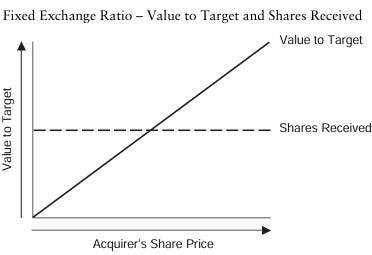
In fix exchange ratio structure, offer price per share move in line with underlying share price of acquirer, the amount of share received however remain constant. following a deal announcement, market immediately start to assimilate the publicly disclosed information. In respond target & acquirers share price start reacting in line with those perception. Therefore, target assumes risk of decline in acquirer share price but retain potential for upside.
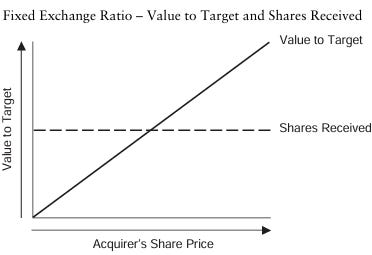
Fixed is generally used more than floating to link both parties to share risk together.
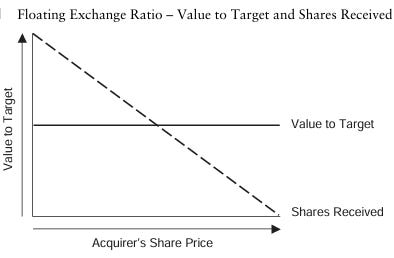
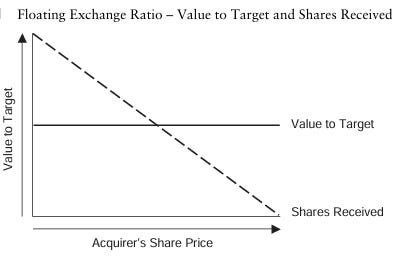
Floating exchange ratio: It set the dollar amount that acquirer has agreed to pay for each share or target’s stock. For eg, targets shareholder will get $20 worth of acquirer share for each share. In floating exchange rare as opposed to fixed has fixed dollar price per share & no. of share exchange fluctuate in accordance to share price movement. Number of shares depend on average share price of acquirer for time prior to transaction close.
This structure provide target’s shareholders with good degree of precision on value received as acquirer assume risk of decline of share price.
Mix of cash and stock transactions: Under this transaction acquirer offer a mix of cash and stock as a purchase consideration. Cash portion represent a fix value per share for target share holder and then stock can be either fix exchange rate or floating exchange rate.
Offer Price = Cash offer price per share + [ Exchange ratio x acquirer share price]
Equity value = Offer price x targets fully diluted share o/s
Enterprise value: EV is total value offered by acquirer for targets equity interest, as well as assumption of targets net debt.
Its calculation is same as its done in comparable company analysis
EV = Equity value + debt value + preference share + non controlling interest - cash
Calculation of key transaction multiples:
Key transaction multiples in precedent transaction mirror those used in comparable company analysis
Equity value as represented by offer price of target’s equity is used a multiple of net income. Enterprise value is used as multiple of EBIT, EBITDA and sales.
multiples in precedent transaction analysis is calculated basis of LTM available at time of announcement.
Equity multiple: Offer price/LTM diluted EPS
EV multiple : EV/ LTM EBITDA, EV/LTM EBIT, EV/LTM sales
Premium paid: Premium paid refer to incremental dollar amount per share that the acquirer offer relative to targets unaffected share price expressed in percentage, Its only relevant for public target companies.
Closing share price on day prior to official transaction announced typically serves as good proxy for unaffected share price.
In event that target has publicly announced its intentions to pursue “strategic alternative” or there is a major leak prior to announcement, targets share price might increase in anticipation of potential takeover.
In that case targets share price before transaction announcement is not truly unaffected therefore here we will examine price paid at share price before leak or announcement.
Calculation of premium = Offer price per share/unaffected share price - 1
Synergy: synergy refer to expected cost saving, growth opportunity and other financial benefit that own due to control of 2 business, it become important to analyse it when strategic buyer is purchase target. synergy represent opportunity to increase future cash flow & earnings above and higher than what could be earned in standalone basis. Therefore, higher benefit synergy lead to higher purchase price paid by acquirer. upon announcement public acquirer give information about guidance on nature and amount of expected synergy. synergy provides a great perception on price paid and multiple.
In precedent transaction analysis it is important to note the announced expected synergies for each transaction when such information is available, however transaction multiple are shown on basis of target reported LTM information without synergy. For a deep understanding of particular multiple paid banker shows a adjusted multiple that reflect expected synergy.
Typically involving adding full effect of expected annual run rate cost saving synergy to earning metric in denominator.
Synergy adjusted multiple : EV/(LTM EBITDA + Synergy)
# Bench marking comparable acquisitions:
As with trading companies, next step here is to analyse involving a in depth study of selected comparable acquisition so as to determine those most relevant for valuing target. As a part of process banker re examine business profile & benchmark the key stats & ratio’s to find the most appropriate acquisition. Each acquisition is closely examined as part of final refining with best comparable acquisition is identified & outlier is eliminated. As would be expected recent deal involving a direct competition with similar financial information is more relevant than older transaction from different point in business cycle and credit cycle.
#Determine Valuation:
The multiplier of selected comparable acquisition are used to find out implied valuation of target. while multiple used vary by sector key multiples used is EV/EBITDA and Equity multiple. banker generally use mean and median for universe to set preliminary valuation range, with high & low also serve as references.
As noted valuation is a art in addition to a science therefore, while mean and median can be used to find the initial value banker use multiple of closest 2 or 3 best transaction. The chosen multiple is then applied to targets LTM financials to determine implied valuation of target.