

“The equity risk premium is the price of risk in equity markets — the premium that investors demand for investing in risky equities instead of a risk-free investment.”— Aswath Damodaran
Returns in finance is measured as sum of Risk free rate and Risk premiums to compensate for the additional risk, the additional risk investors bear for investing in equity markets is known as Equity risk premium
What is Equity risk premium (ERP)?
Equity risk premium is the extra premium that an investor will ask for investing in a countries equity market over and above the risk free rate of the countries currency to be compensated for the extra risk associated with the equity markets.
The core concept that explains a risk premium is extra return for extra risk.
We know bonds have fixed payment obligation but equity returns are implicit that is when you buy the share it is not written on it that it will give you a specific return, in fact the returns of equity is far more volatile than bonds thus making equity riskier than bond. Not saying bonds are risk free their returns are volatile to changes in interest rates but compared to equity bonds are less risky.
Risk from prospective of whom?
Earlier we said that ERP is the extra return an investor expects for investing in equity markets of a country over and above the risk free rate,
But who is that investor? Should we consider any random investor and ask them their perspective of risk in a equity market?
When talking about risk premium we are presumably talking about risk from the perspective of Marginal investors, But who are the marginal investors? and the risk is the extra systematic risk that adds to their well diversified portfolio as a result of adding a particular security.
Marginal investors are institutions who manages a well diversified portfolio, such that they face no idiosyncratic risk or unsystematic risk. unsystematic risk is risk that affect a particular company or sector. unsystematic risk can be reduced to negligible amount through diversification and since this risk can be diversified away therefore they are not rewarded.
“Market only reward for systematic risk”
Systematic risk is Market risk which affect all the securities of the market and cannot be reduced through diversification.
We calculate expected return from the perspective of marginal investors as this entities are well diversified and are not affected by unsystematic risk and therefore are used to calculated additional risk in a equity market.
Importance of Equity risk Premium.
Used in calculation of Discount rate: Equity risk premium is a very important element of Cost of equity and Cost of capital calculation, a higher risk premium leads to higher discount rate which in turn reduces the present value of future cash flows which can make an asset look significantly overvalued compare to a situation where lower risk premium was used.
Investment Decision making: Investors can use Risk premiums to make their investment decisions across geography and asset classes. Equity risk premium is low at time markets are high, when investors don’t feel much fear. We know that price of an asset is equal to Present value of future cash flows, if we use lower risk premium in case of market is at its peak we will be paying more for an asset compared to what we would have paid is equity risk premium of the market was low.
Price of Asset = PV of future cash flows / Discount rate
So, if you believe that stock markets today are overvalued then you implicitly believe that the market has a lower equity risk premium than it should be, when comparing assets across geography and asset classes investors will prefer higher Risk premium over lower. This means if investor believe that equity risk premiums are low compared to corporate risk premium then they will invest their money in corporate bonds than in equities.
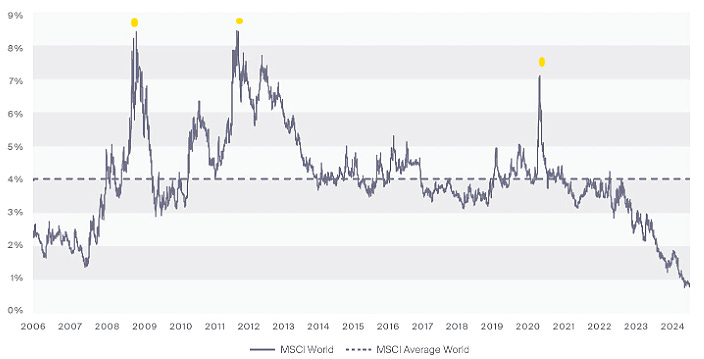
Notice the spike in equity risk premium in 2008 due to Lehman Brothers crisis and 2020 due to the Pandemic. The fall in equity risk premium after the Pandemic justifies the bull run global equities witnessed after the Pandemic.
Factors Effecting Equity risk premium
Risk aversion and consumption preferences: As investors became more risk averse the equity risk premium increases as investors are not demanding higher returns for a similar risk, risk aversion can change due to differences in investors age and consumption preferences. As investors grow old they became more and more risk averse, so it can be said that as global populations average age increases the risk aversion will also increase and thus increase equity risk premium.
Chart A
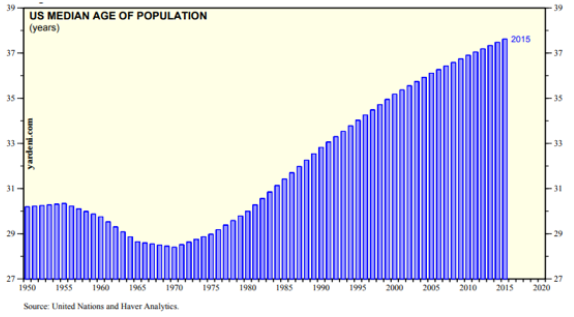
Chart B
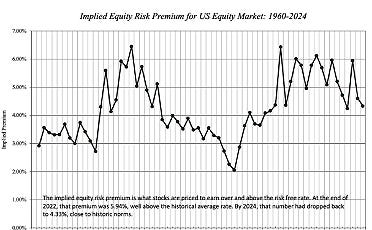
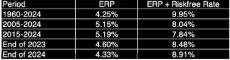
As seen in Chart A and B we can say as the population in US is getting older we are seeing a increase in average equity risk premiums.
Consumption preferences, we will expect the equity risk premiums to increase if the investors prefer to consume today rather than save for future, in this situation you have to give an investor extra returns to defer his consumption. Thus ERP increases as savings in a economy decreases.
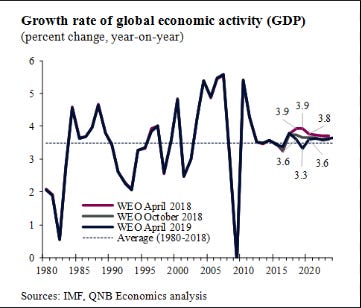
Economic risk: Fluctuations in economy affect all the firms irrespective of how diversified you are economic risk can affect your returns, simply more volatile a economy is greater is the ERP. Economic variables such as inflation, interest rate and GDP growth effect the return an investor can expect from the economy, More stable and predictable a economy is lesser is the ERP.

Global Economic growth fluctuations have reduced in last one decade, as a result the Global ERP has reduced.
Liquidity and Fund flows : Another risk that affect all the equity investors around the globe in liquidity, if investor has to realize his security at a discount as their are less participants ready to purchase security in the market then market is said to be illiquid. Liquid market is a market in which investor can sell his investment quickly at a fair price. when liquidity decreases investors demand higher premium to compensate for less liquidity.
Another way to measure liquidity is fund flow, either from other assets or geography. If fund flow into an equity market increases, equity risk premium shall decrease every thing else being constant. whereas fund flow out of market should increase the ERP. This argument justify lower equity risk premium in growing economies like China and India where there is restriction on investment in foreign markets.
Different methods to calculate equity risk premiums:
Now after understanding what equity risk premium is and how important it is for valuation, we now focus on different ways to calculate equity risk premium:
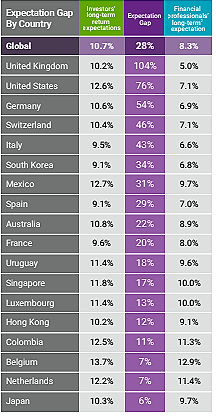
Survey Approach: Equity risk premium is what investors expect for investing in risky equities over and above risk free rate. so it sounds quite reasonable to use survey approach to ask investors about there expected returns. broadly we can ask retail investors and institutional investors about there expectations on returns from equity. The problem is that this approach may sound reasonable but it is quite unrealistic to ask each investors about there expectations on equity returns, one argument could be to not include retail investors and only ask institutional investors about their expected return but still this approach can be quite costly an impractical to use. One such institute that conduct such surveys is Natixis, below is the extract from their latest report.
Their are 2 main advantages of using a survey approach:
A.) They change responsively to recent stock price movement with survey number increasing and decreasing after a major market event.
B.) Survey numbers can be used to predict market movements as when investors became too optimistic about the market it is a sign of upcoming shortfall.
Historical Premiums: Most widely use measure of equity risk premium is historical risk premium. In this approach actual return earned by stock market over and above default free security is calculated and taken as equity risk premium. (RM- RF) i.e Return from market - returns from default free securities.
Their exist some issues while using historical ERP:
Question about how far to go? Ideally longer the time frame better the estimate as longer time frame means smaller standard error,
Std error = Std deviation/√n
As sample size increases standard error decreases, Some might argue that shorter time frame is better representative of current trends and going far back 100 years is irrelevant as market perception towards risk has changed significantly towards risk, they are right but the disadvantage due to increased std error will far succeed the benefit of using a shorter time frame.
Secondly, question might arise on what type of average to take? Arithmetic or geometric, Academicians have proven that geometric average benefits far succeeds arithmetic average benefits when using the number in forecasting for multiple years.
Lastly, we must understand what risk free rate to take to compare with the market return, 1 year risk free rate or a longer 10 year risk free rate? Some practitioners argue that using a short term risk free rate is better as it has no effect of changes in interest rates that long term risk free rate has, but they need to understand that there exist a re-investment risk that will emerge once a 1 year bond expire and you have to re invest it in another 1 year bond which might not be same as previous. therefore its better to use risk free rate to compare market returns same as risk free rate used in estimation of expected return.
All seen if we have to use historical ERP in our valuation it is best to use long term returns of market and bonds, use geometric average over arithmetic and being consistent with the risk free rate used in expected return calculation to be used when compared to market return,
Another issue that might be observed when using historical ERP is adding a troublesome year such as 2008 returns will reduce the risk premium as equity markets performed poorly and contrary to it bond market performed well,This will also increase if we a year such as 2009 which gave great returns due to smaller base. This is contrary to our research that we did that market feels more fear at bottom and less fear at the top.
Implied ERP: In valuation our inputs should be forward looking, when we discount future cash flows it does not make sense to use a discount rate which is backward looking and assuming same in future, rather our discount rates should also be forward looking. This method does not depend on historical data rather assumes that markets are perfectly priced.
DCF based model: Its based on simple valuation belief, the value of a security is present value of future cash flows. for example an asset pays you $5 till perpetuity and you are willing to pay $30 for the security than you are implicitly assuming a required rate of return of 16.66% (5/30).
Consider a simple equation: Value = Expected dividend and buybacks next year/(Required rate of return - Expected growth rate)
4 out of 5 inputs can be derived very easily being: Market price of index, Expected dividends and buybacks next year, Expected growth in earnings and dividends in long term. the only unknown is required rate of return which can be calculated using this equation.
Model assumes that companies pays out their residual cash flows in form of dividends
For example: Current price of S&P 500 is $1000, expected growth is 2.5%, Dividend yield is 10%. we can estimate required rate of return as
1000 = 100(1+2.5%)/(r-2.5%)
solving the equation gives us r of 7.75%. Subtracting Risk free rate lets assume 4% give us a ERP of 3.35%.
We normally divide the periods into high growth periods and terminal growth period cause we cannot assume growth rate to continue to be larger than economic growth till infinity, normally we attach risk free rate as terminal growth rate of index till infinity.
But why are we taking Dividends and buybacks as cash flows from an index but not the actual cash flows of each of the companies that makes up that index and then find required rate of return??
In this model we assume dividend and buybacks as proxy for Free cash flows from each firm as calculating free cash flows of each firm in an index can be a lengthy task,
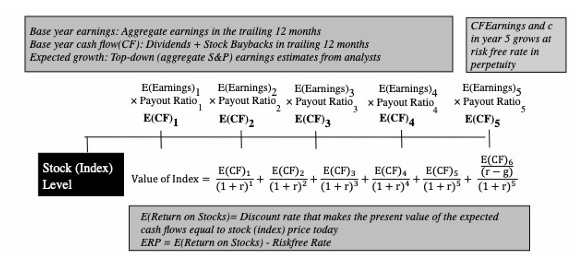
The above chart shows how to calculate implied ERP for an index
Benefits of Implied ERP:
Forward looking: In contrast to historical ERP implied ERP is forward looking as required by valuation, it forecast future cash flows from an index and try to find a rate which will bring the future cash flows to present price.
Dynamic: Equity risk premium changes as price of index changes. Its sensitivity to market prices are tool to study market trends.
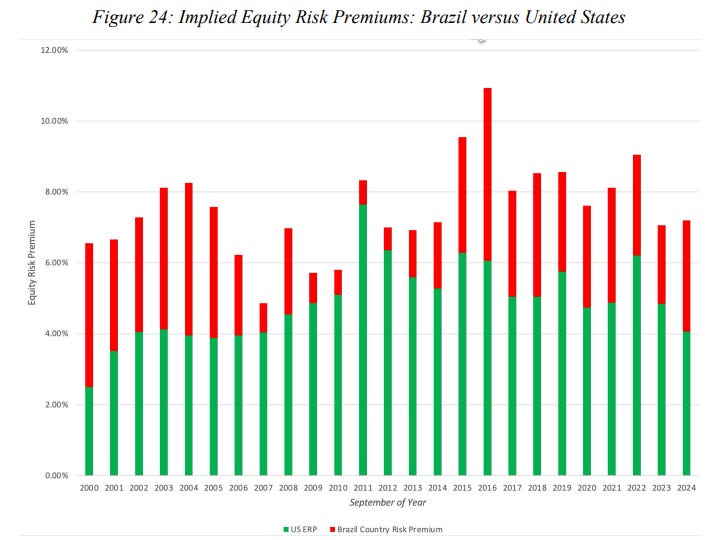
The Implied ERP of brazil showed volatility being stable during periods of 2007 to 2104 but then showing a spike from periods beyond that due to political turmoil
Spread Approach: The logic behind this approach is simple, not all equity markets are similar in terms of risk. Some are riskier than others for example, If you have been given $1000 and asked to invest in 2 markets :
A. USA
B. Mexico
The expected return from both the market are 6% where will you invest?? Definitely in US because it is a less risky market compared to mexico. Now we know mexico is riskier than US but how much riskier and how can we quantify this risk ? Answer to this question lies in Country risk premium.
Country Risk
Surely some countries are riskier than others, you can’t say that the amount of risk a investor face in US is same as Brazil, India or Nigeria. definitely some countries are riskier than others, but what makes them riskier and should the investor be compensated for those risks? and why should we care ?
We should care about country specific risk as :
Investors are increasingly diversifying there portfolio to include companies of different countries to diversify their risk and to get extra returns, this exposes them to various country risk which they should know.
Domestic companies are also expanding their operations in different countries and thus getting exposed to their risk, an investor investing in that company should understand the country risk exposure the company has.
Sources of Country risk :
Stage of Life Cycle: Similar to Corporate Life cycle which shows how mature a company is to make estimates of its key features like growth, risk etc, we can use a country life cycle to see which stage the country fit and make estimate about the level of growth and risk we can expect from that country.
Countries in early stages of life cycle can be expected to have a greater risk than country in mature stage.
Political Risk: Political risk can include components such as type of government (democratic or Autocratic) many individuals believe authoritarian style of government leading to more control can reduce country risk as the government can take actions on required matters quickly but the drawbacks of an authoritarian government far succeeds its advantages, various drawbacks cold include increases corruption, violence leading to increase in country risk.
Legal Risk : Companies and investors are more than concerned about a countries laws and regulations because they have to operate under it, if the legal system is not matured to provide justice to company in any matters, it can have serious consequences for the company. countries having an underdeveloped legal system can have a greater country risk
Economic structure: If a country derive maturity of its economic output from a single commodity than its a serious risk as a decline in commodities price or a decline in its demand can have a negative consequence for the country.
simply, a Emerging countries ERP can be calculated by Adding country risk premium to US ERP, Since we assume US to be risk free.
Emerging country ERP = US ERP + Country risk premium.
We can quantify country risk premium in 3 ways:
Market interest rate approach: If a government issues bond in foreign currency then the interest rate on the bond compared to a risk less investment in that currency gives us country risk premium of that country.
For example: Brazilian govt 10 year $ denominated bond yield = 6.5%
10 Year US treasury bond rate = 4.24%, US ERP = 2.5%
Brazilian country risk premium = 2.3%
Brazilian market ERP = 2.5 + 2.3 = 4.8%
Sovereign rating approach: We can use countries default rating and assume that the country has a similar country risk as all the countries in that rating and is any of the country in that rating has a US denominated bond we can use that spread and apply it every other country having similar ratings. This ratings are provided by moody’s and S&P.
For example : India’s rating is Baa2, US ERP is 2.5%. we will look the ratings and equivalent spread let say 2.16% then Indian ERP will be
US ERP + Country risk premium
= 2.5% + 2.16%
= 4.66%
CDS: We can also use countries CDS spread as representative of country risk premium. but here’s a catch, we will have to use countries CDS net of US CDS because even if US is assumed to be risk free it still has a CDS spread this means an emerging country even if it became mature will have at least this spread,
US CDS spread = 0.50% US ERP = 2.5%
Indian CDS spread = 0.84%
Net of US = 0.34%
India’s Country risk premium = 2.5% + 0.34%
= 2.84%
Relative Approach:
Goldman Approach: This approach calculated ERP by comparing Standard deviation of 2 equity market, the emerging market and a base market usually US
Emerging market ERP = (SD of country/ SD of US)* ERP of USA
For example: SD of Indian equity market is 3%, SD of US equity market being 1.5% , US ERP is 2.5% then using this approach India’s ERP will be 5%
Melded Approach: If we don’t want to use a mature countries ERP to calculate country risk premium we can calculate it using countries bond market data.
simply stating,
Equity risk premium = (Default spread on Govt bond/ SD of Bond market) * SD of equity market
For example: Default spread on Indian govt bond = 2%
Standard deviation of bond market in India = 1.5%
Standard deviation of Equity markets in India = 3%
India ‘s ERP = 4%
Nicely Explained Piyush !